How I Won $100,000 in a Week by Finding a Hidden Arb in PrizePicks’ “Stacks” Product
- Event
- MLB — PrizePicks Stacks, California “Champions” contests
- Market
- Fully correlated Stacks parlays (HR / multi-hit legs)
- Odds
- 37.5x
When PrizePicks launched their Stacks feature, they plastered it everywhere — a massive banner on the home screen that I’m sure millions of users saw. Out of curiosity, I clicked through and started reading the fine print.

Stacks let you take the same player for multiple stats in one lineup. “No more choosing one stat; if you really believe in your player, now you can stack their picks.”
But if I pick a player to hit a home run, I could also pick them to go over 0.5 runs and over 2.5 hits + runs + RBIs, all of which are fully correlated. If the home run happens, those other props automatically hit as well.
Naturally, the first question that came to mind was: Did they forget to account for correlation? If they didn’t, this could be a gold mine. I went digging.
Building the Lineup
My first thought for baseball was to bet on 3 completely correlated legs.
If a player hits a HR by default they get the following other stats:
- 3 Hits+RBI+Runs (hit on their o2.5)
- 4 Total Bases (hit on o3.5)
- 1 Run (hit on o0.5 Runs)
- 14 Fantasy points (hit on their over FPts)
- The 4th leg is a random non-correlated leg that will never push out. Basically any even line (PrizePicks offers even overs and unders) that usually has a stat that ends in 0.5 (for example: o/u 5.5 K’s)
We’ll take the hit and halve all our payouts by making 2 lineups for every player.
- HR + 2 implied legs + under (random leg)
- HR + 2 implied legs + over (random leg)
Now we have a 4-leg parlay where we automatically win if the player hits a HR.
What Happens in Regular PrizePicks Stacks
For the Stacks product, PrizePicks does account for correlation risk. If your three legs are perfectly tied together, they cap the guaranteed payout at the odds of the least likely event — in the HR example, roughly 4–5×.
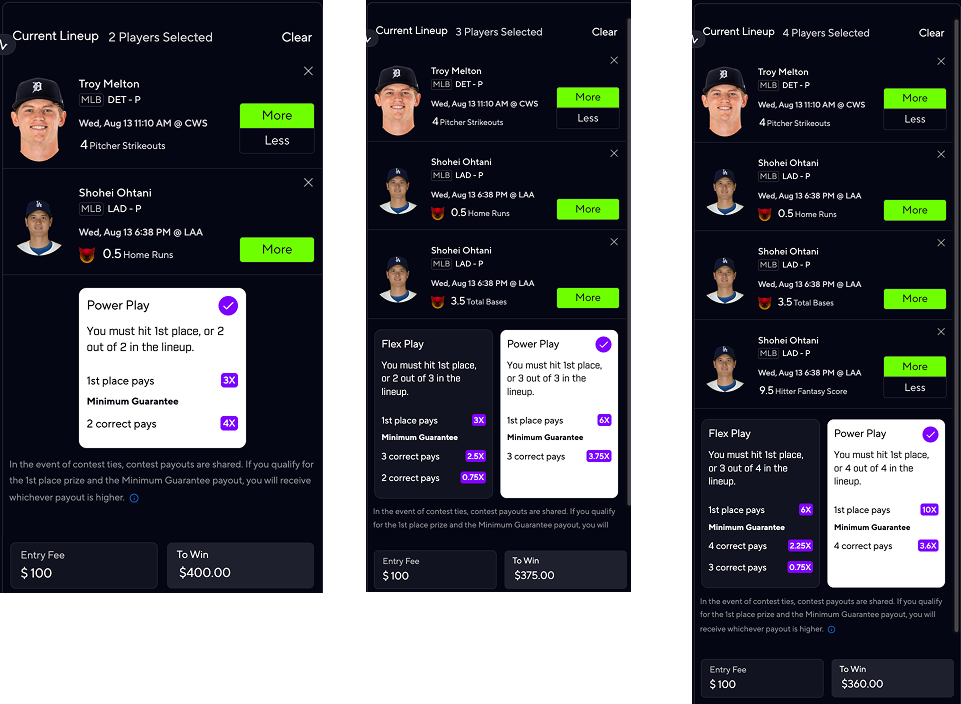
They actually lower the guaranteed payout! The same 2-leg parlay went from winning $400 → $360.
That part wasn’t surprising. It’s the logical way for them to protect against obvious arbitrage.
The Twist: California’s “Champions” Contest Prize Pool
But then I noticed something strange. Because I’m in California, PrizePicks runs their Pick’ems as a contest format — you’re put into a 100-person field against players of “similar skill level” (based on experience tiers like Rookie, All-Star, Superstar). First place in that field gets a 10× payout for a 4-leg parlay.
PrizePicks labels you a “Superstar” once you’ve done one of a few basic things: placed at least 500 bets on their platform (regardless of outcome), collected a total of $2,500 in winnings across at least five contests (not necessarily profit, just total payouts), or won at least three contests with payouts of $1,000 each. Nothing particularly difficult or specific to categorize a winning player. It more-so shows you’re a long time player or a player making big bets.
I’m fairly confident this whole format and the first place prize exists purely for legal reasons. If this 1st place prize mattered, the prize structure makes no sense. Two users who tie for first place, both having a guaranteed 10×, would only win 5× (the 10× prize split 2 ways) for their first place prize. So PrizePicks would be paying out the guaranteed win of 10× regardless. If PrizePicks truly cared about this prize mattering, they would add additional structure to handle tie situations differently. Also, in most normal cases with uncorrelated parlays, the 1st place prize is identical to the guaranteed prize, so again it doesn’t matter.
PrizePicks Moves to Peer-to-Peer Daily Fantasy Sports Contests
By structuring payouts as a “pool” where users compete against each other, PrizePicks can position their product as peer-to-peer gaming (like Daily Fantasy Sports) rather than traditional betting or parlays. This helps them operate in states with stricter gambling laws.
Now here’s the critical part: If we can ‘win’ our pools consistently, we’ll get a 10× payout instead of the 3.6–5× payout.
Pools Scoring
Scoring is straightforward:
- Correct pick = 1 point
- 1.05 if it’s a Demon pick (harder)
- 0.95 if it’s a Goblin pick (easier)
- Tie/DNP = 0.5
- Wrong pick = 0 points
At the end:
- The player(s) with the highest score in the group win first place.
- First place pays 10× your entry for a perfect 4-leg.
- If there’s a tie, PrizePicks compares the split prize to the normal guaranteed payout — you get whichever is bigger.
So this is where the second advantage comes into play.
Demons are all treated identically for the pool score. If you hit on the craziest 4-leg parlay — 4 demons for a 595× (4 random players to all hit HRs) — you score the same as another guy who has 4 demon legs that are all +150 odds (40% to hit). They both score 4.2 points.
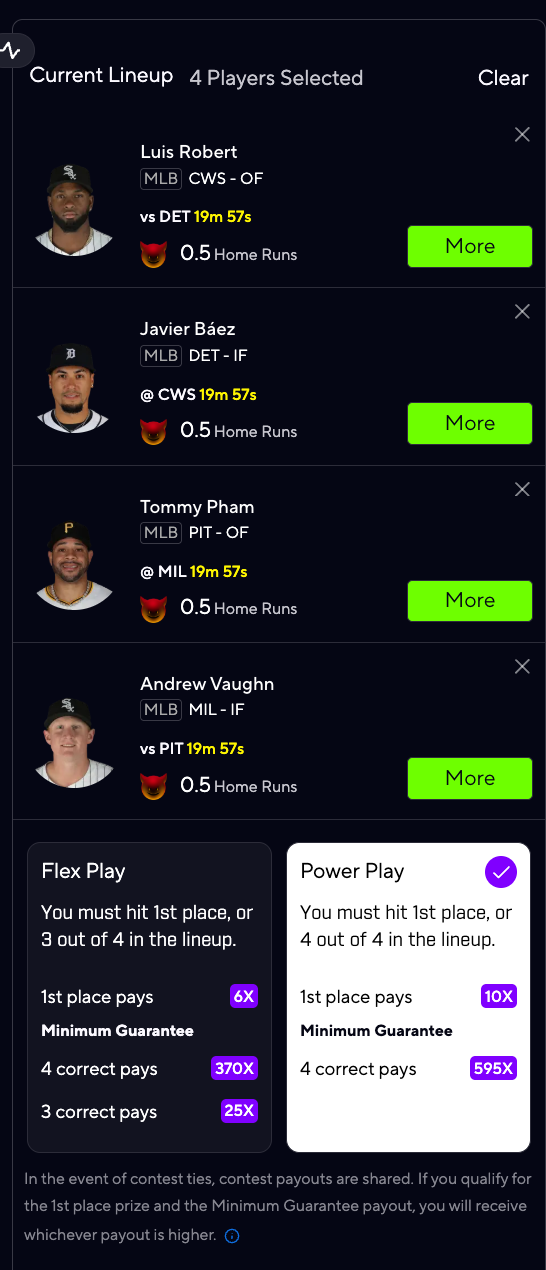
Again, the reason why this doesn’t matter in almost all cases is because the guy who hit his HR parlay had a 595× guarantee, so he doesn’t even want the 10× 1st place prize.
Back to our example. We know we’ll have at least 1 normal leg (the random leg) and 1 demon leg (hitting a HR). Given our player hits a HR and our parlay hits, what’s the probability we win the pool with a 4.05 score (1 demon), a 4.10 score (2 demons), and a 4.15 score (3 demons)?
In a vacuum assuming all odds are exactly 50-50, the number of expected 4-leg parlays in our pool of 100 to hit is 6.25. So can we edge these couple lineups out with our demons?
Time to finally do some math:
Math Breakdown of the Edge
- X-axis = Hit Rate (%)
- Y-axis = Max Payout Probability (%)
- Colors = EV% (green = profitable, red = negative EV)
- Black dashed line = Example max payout probability (80%)
- Purple dashed line = Example hit rate (28%)
- Blue line = EV = 0 break-even curve

This version uses the correct formula:
EV% = ( c · [ (1−q)·m + q·M ] − S ) / S × 100
Where:
- S = 100 (stake, remember this is 2× $50 bets, since we have to have an o/u on the last leg)
- m = 250 (min payout, don’t win the pool and using the guarantee)
- M = 500 (max payout, win the pool and getting the 10×)
- q = Probability we win our PrizePicks pool
- c = HR Rate
We fit squarely in the +15–20% EV range, if we can have an 80% probability to win our pool + a 25% implied HR rate.
Why This Works
The “guaranteed payout” clause means the contest format doesn’t properly de-risk correlated legs like the standard product does. In practice:
- You’re matched against 99 others who might have similar correlated plays.
- But in the event of a tie, you’re still getting the max payout as if you solo-won.
- Effectively, the downside that should exist (splitting first place) disappears.
It’s an edge that likely exists only because the contest payout structure and the guaranteed payout system weren’t designed with correlated Stacks in mind.
Evolution: (August 15th)
I realized while making parlays PrizePicks offers 6-leg parlays too! With a 37.5× return, instead of having the dummy leg, I could parlay 2 3-leg events. Immediately this is interesting because we don’t have to split our profits in half.
Finally I realized the ultimate answer… an MLB player to have >1.5 hits, which means they have >1.5 TB and >1.5 Hits + RBI + R.
Turns out >1.5 hits is a demon because it’s slightly favored for the books, but for good players it’s basically 30–40%.
We can parlay 2 players each with +160–200 odds to each get at least 2 hits. 35% odds for each to hit, so ~12.3% for the parlay to hit.
We have a 12.3% for our parlay to hit a 37.5× with ~2 demons. I assume if others haven’t figured this out that means we have an EV of 2.8 — otherwise said, for every dollar we bet, on average we profit $2.80.
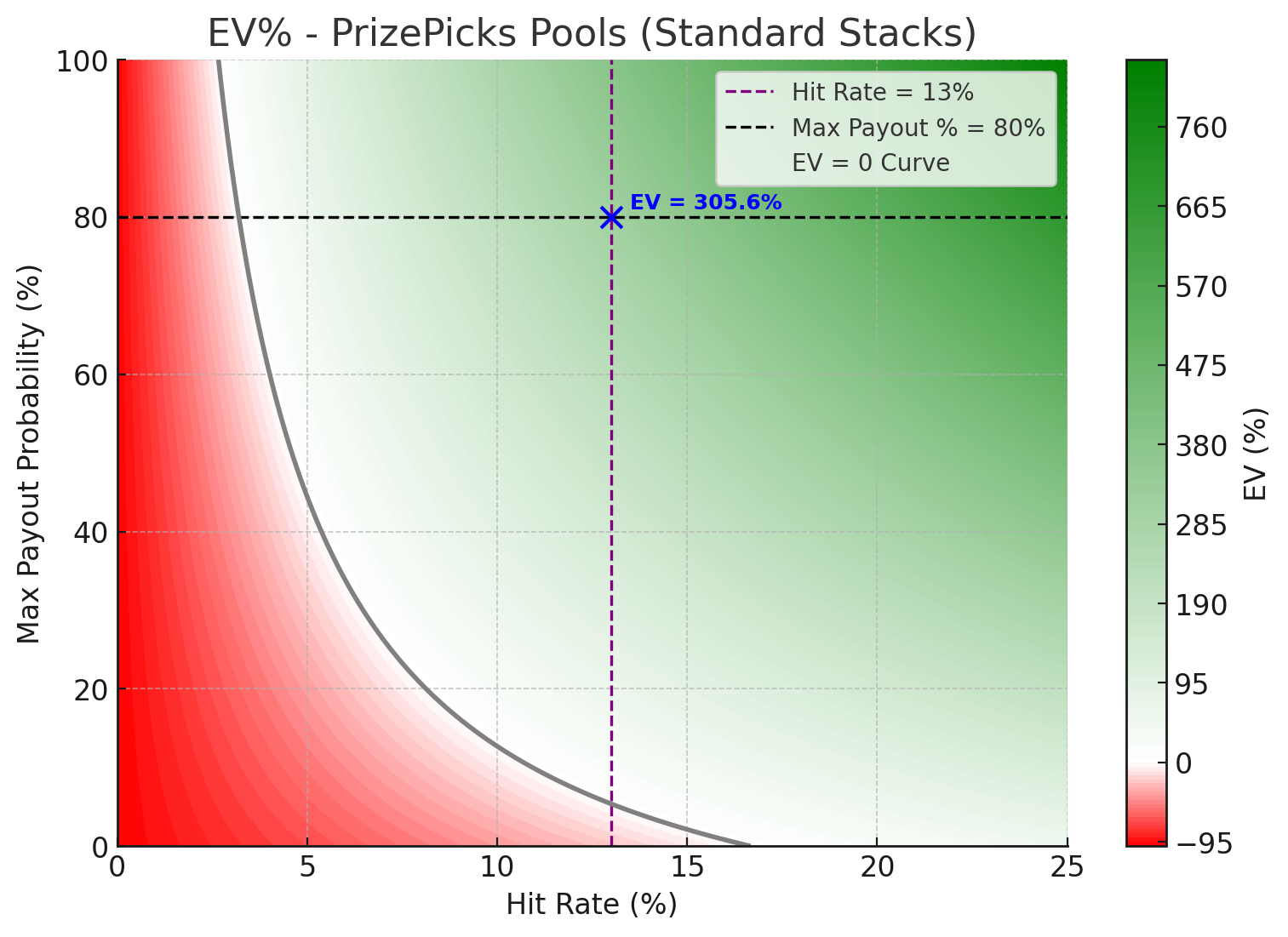
Updated chart with the new bets (>1.5 Hits).
Evading Detection
I only bet $1,000 a day per account. That’s 10 $100 6-leg parlays with an average EV of 2.8 (i.e. profit of $2,800 per day per account).
This accomplishes 2 things:
- I think there’s a secondary detection test if you go over that limit.
- For your open bets, you can only win $6,250 per player. Since we’re using a player 3 times, the way PrizePicks counts this is 3× on the guaranteed payout. So for a single parlay where I use a player they count for ~$2,100, i.e. I can only use a single player 3 times per account.
- This is speculation, but the way that the system works is that PrizePicks actually pays me out my guaranteed amount first, and then after the pool closes they pay the first place prize out. There’s a world that this secondary payout doesn’t trigger detection immediately and we can skate by for the next month or so?
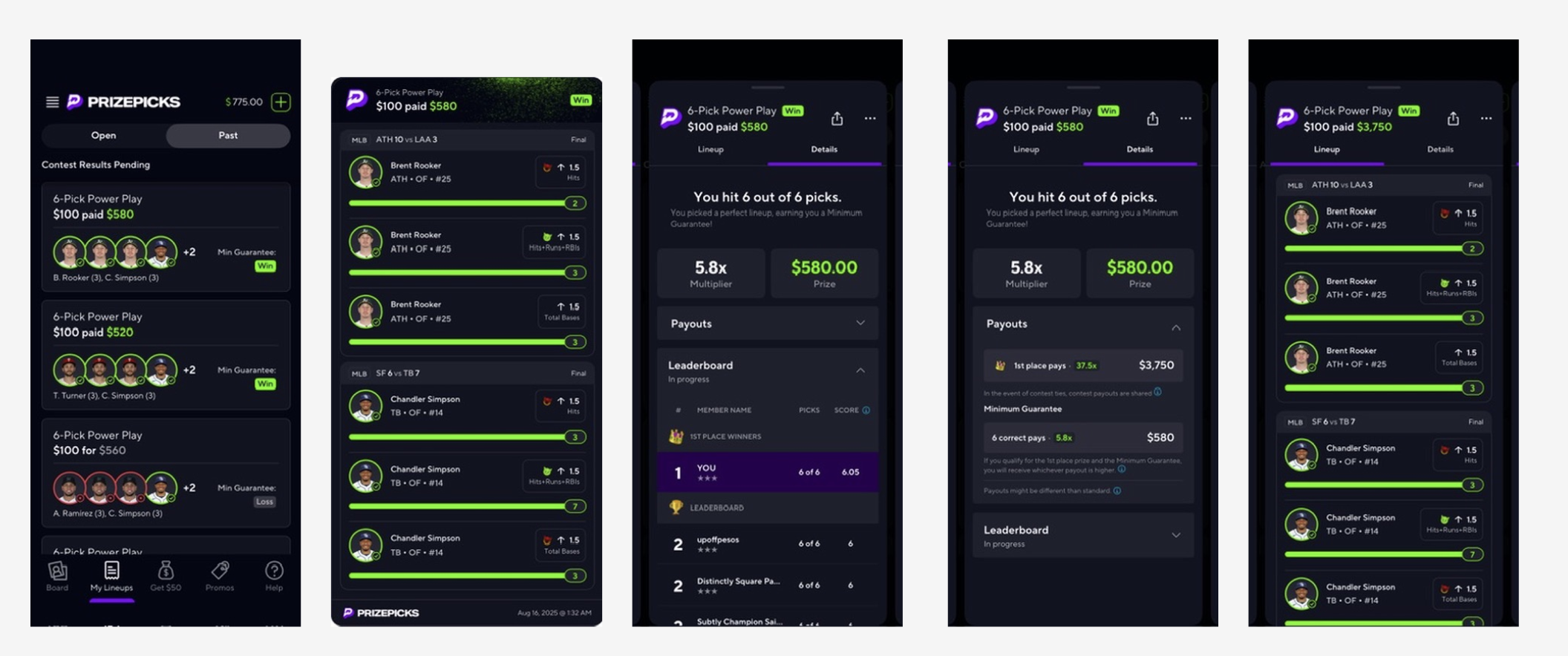
PrizePicks updating my winning lineup after 24 hours. The first 4 screens show that we’re confirmed as the 1st place winner for $3,750, but it takes the night for them to update the payouts from $580 → $3,750.
How many accounts can we add?
Adding more accounts obviously increases the EV, especially since I have almost infinite EV to be playing with. But it increases the probability of collision between pools.
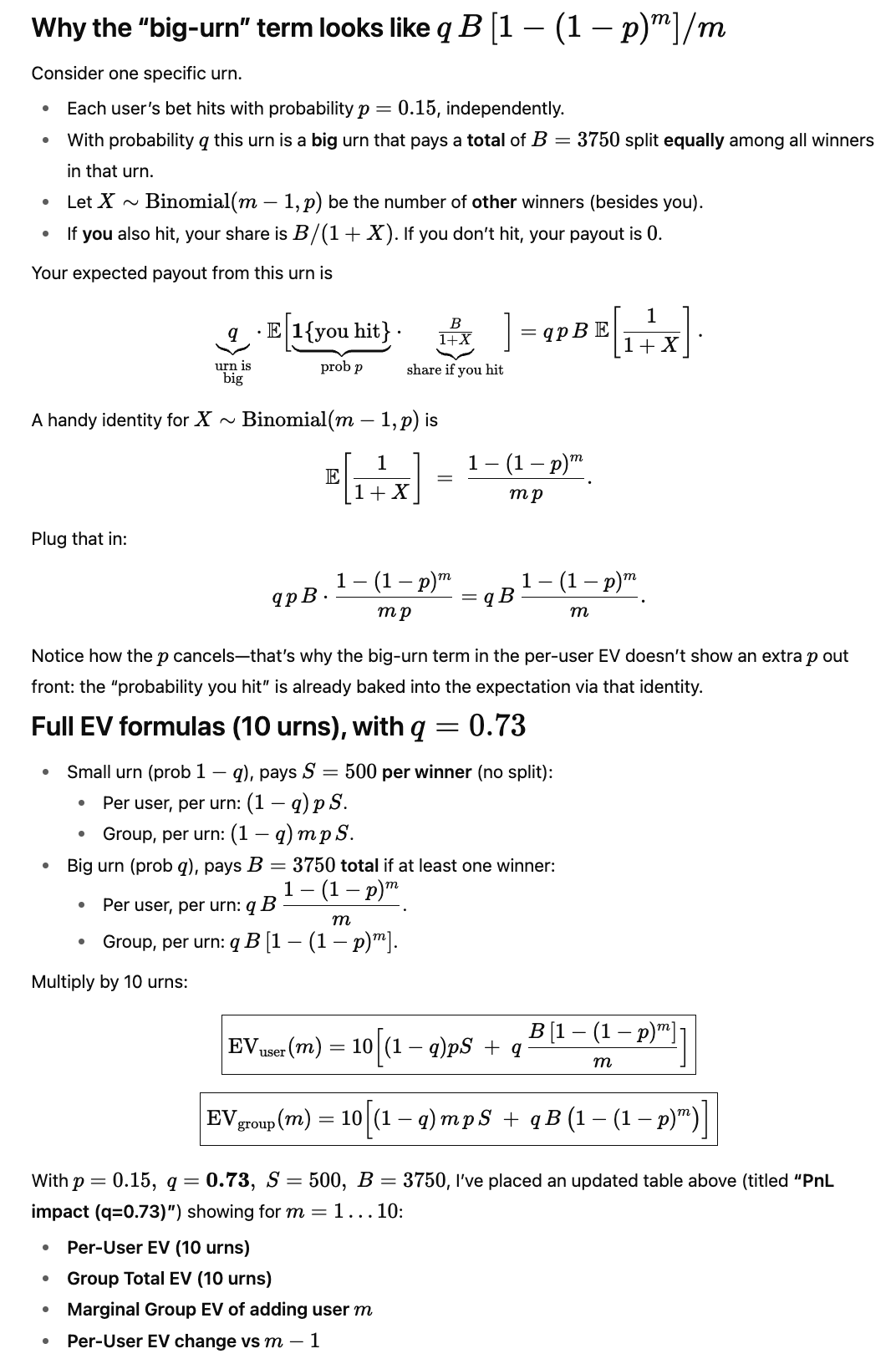
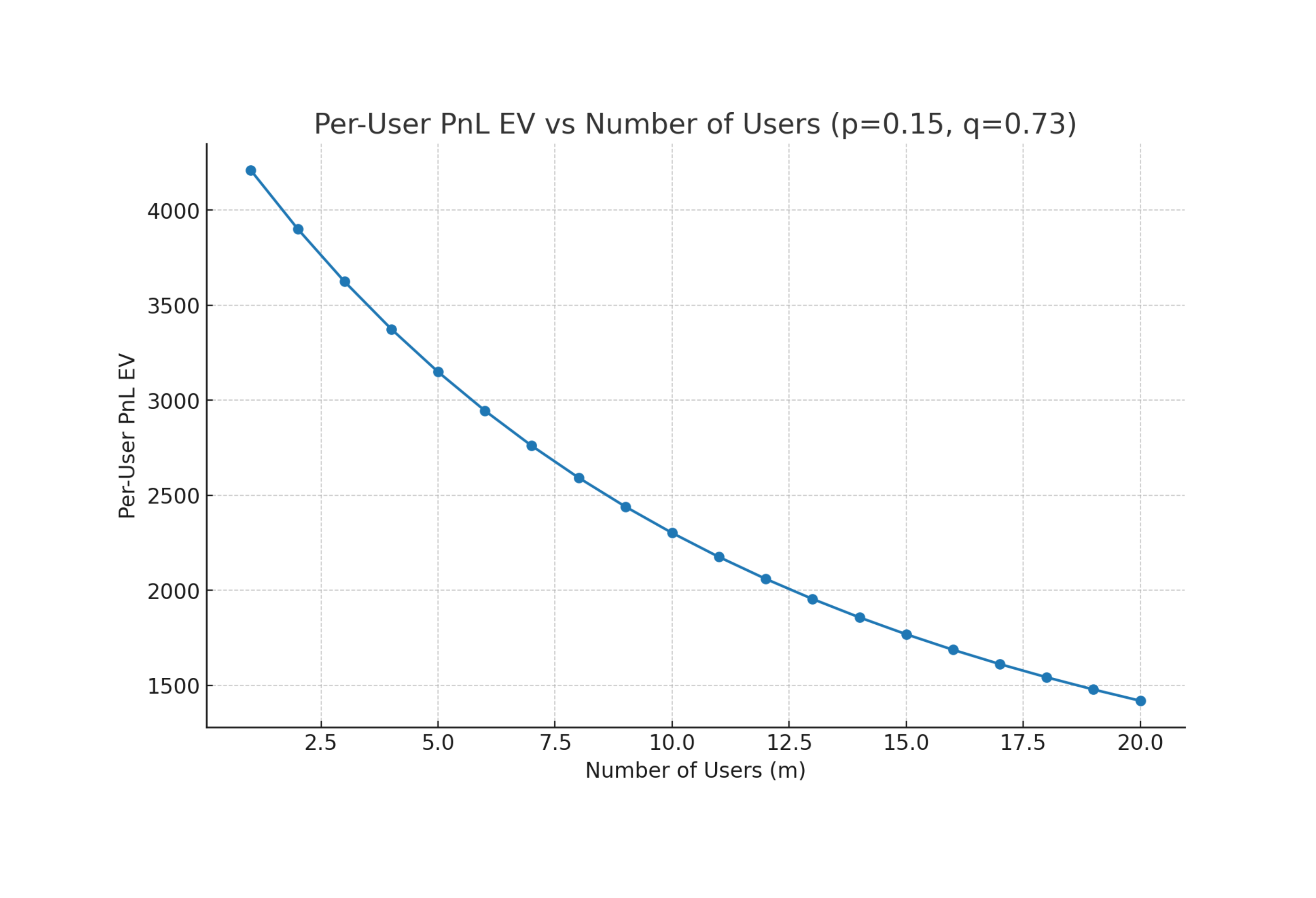
This is the math problem I’m trying to solve:
You have a group of n friends. Each friend has 10 balls. 2 of those balls are red.
Final Thoughts
I’m sure I’m not the only one who spotted this. I don’t have any complicated systems in place. It just took a little bit of digging and the ability to be a bit more curious than everyone else. But it’s a good reminder: sometimes the best edges aren’t in the odds themselves, but in the rules that govern how those odds are paid out.
On this note: I highly recommend watching Jerry and Marge Go Large.
There’s tons of opportunities, big and small. We just have to go and find it.
Stay Curious!